Showing posts with label Kim8-14. Show all posts

Wednesday, June 15, 2011

Kim's 2 Minutes Reflection

1.

Google Doc.


Animal Cruelty: 1st Draft


Animal Cruelty: Final Draft


2. We have made a few changes to our final draft from our first draft. One of them was we added narration to the video. We also had changed the credits by changing the background colour so it would show up better. My group and I had made the music go on longer instead of stopping suddenly at the end. Yes, the student comments were very helpful in making our final cut better because we know that the audience would like to see in our video.


4. Unfortunately, we were unable to find an expert to help us with our project. We were unsuccessful because we did find one in the beginning but we found out that they were unable to give us information on our topic. We had attempted in finding another expert but we didn't have that much time left because some of our group was on the music trip.


5. I think that our greatest success in our 2 Minutes project was that we were able to complete it on time and at the best of our ability. I also think that we did a good job on finding and adding as much information to our video that we can in the time that we were given. Skills that I will take with me and use in the future are skills in how to make a movie and how to give advice to other people in how to improve their projects.


6. One thing that frustrated us was having to add our information and pictures to our video in a way that everyone liked. We were able to become successful by compromising and being able to organize our video with a little of the ideas our group members came up with. Another frustration that we had was having to add narration to our video. We were able to overcome this by asking one of our fellow classmates how they added narration to their video.


7. The 2 Minutes project is important to Grade 8 students because it made us aware of the many problems that are going on in the world. This has helped us understand these problems and learn how to make others aware of them. This project was also important because we learned how to make an informative video and work with a group. We also learned how to give constructive criticism to our schoolmates by giving them advice on how they could improve their video. Most importantly, we learned many ways we can take action and try to end these problems.


8. I will make a difference in the future by informing others about animal cruelty. I will also make a difference by avoiding purchasing products that use animal testing and by not abusing animals. I could also volunteer at local animal shelters.

Sunday, May 8, 2011

Kim's Algebra Post

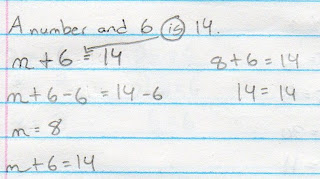
Variable - a letter that represents a number in an equation or expression. ex. n+6=14
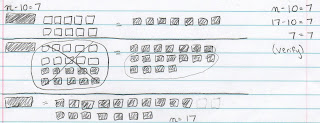
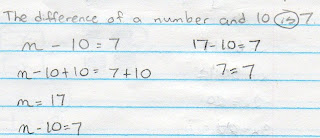
Constant - the integer in an algebraic expression or equation. ex. n-10=7
Expression - pattern- many answers. ex. 2x
Equation - only has one answer, has an equal sign. ex. 2x=6


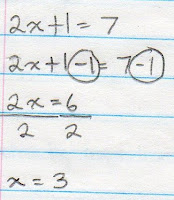
One-Step Equations

Steps:

1) Isolate the variable.
2) Cancel using the opposite
-constant is cancelled with zero pair
3) Balance - do the same operation on the other side of the = sign.
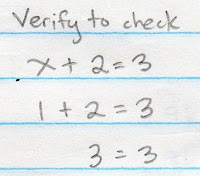
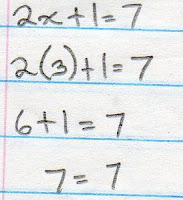
4) Verify to check.


Addition Question


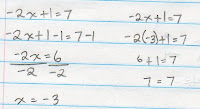
Subtraction Question


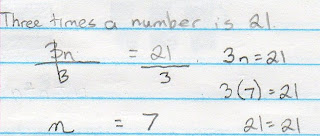
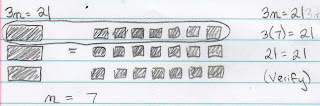
Multiplication Question


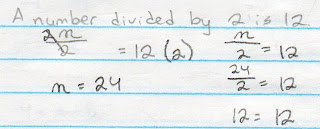
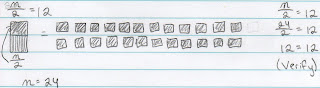
Division Question


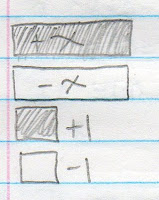
Algebra Tiles


- Isolate the variable
- Cancel the constant using zero pair
- Balance - do it to the other side
- Verify to check


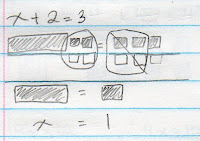
Addition


Subtraction


Multiplication


Division


Two-Step Equations

Steps:

1) Isolate the variable.
2) Cancel the constant.
3) Balance.
4) Simplify the variable.
5) Balance.
6) Verify.


Verify to check.


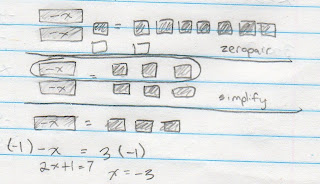
Using Algebra Tiles To Solve Two Step Equations


Algebra Tiles


Here's links for one-step and two-step equations.

One-step Equations Video


Two-step Equations Video

Tuesday, March 22, 2011

Kim's Great Big Book Of Integers

Chapter 1: Grade 7 Integer Review

In Grade 7, I learned that integers were whole numbers that were positive and negative. They could be represented using integer chips and a number line.


Find zero pairs for the following integers.

-6 +6
+10 -10
19 -19
-16 +16
-11 +11
+14 -14
63 -63

Integers ala Grade 7

have 4 owe 4
(+4) + (-4) = 0

Brackets are training wheels.

Standard form:

+4 -4

4-4 <--- pure standard form

Questions:

-3 - (-7) = +4


-3 - 7 = -10


3 - 7 = -4


3 + 7 = +10


-3 + 7 = +4


Chapter 2

Multiplying Integers

Sign Rule:
Even= when you have an even number of n
egative factors the product is POSITIVE.
Odd= when you have an odd number of negative factors the product is NEGATIVE.

(+2) x (+3) = +6
means 2 groups of (+3)


(+2) x (-3) = -6
means 2 groups of (-3)


(-2) x (+3) = -6
means remove 2 groups of (+3)


(-2) x (-3) = +6
means remove 2 groups of (-3)


Dividing Integers

How many groups of ___ are in ___?
How many __'s go into __?

Partative Division - making parts or groups

6 ÷ 2 = 3
How many groups of 2 are in 6?
How 2's go into 6?


-6 ÷ (-2) = 3
How many groups of (-2) are in -6?
How many (-2)'s go into -6?


Quotative Division - sharing with groups

(-6) ÷ 2 = -3
share groups


When both integers are the same you can use partative and quotative.
(+15) ÷ (+3) = (+5) or (-15) ÷ (-3) = (-5)

You can use multiplicative inverse to help solve 6 ÷ (-2) by finding the answer which is (-3) and switching it with (-2) making the question 6 ÷ (-3) and the answer would be (-2).

Order of Operations with Integers

Brackets
Exponents
Division
Multiplication
Addition
Subtraction

Solve this question:
(+5) x (-3) + (-6) ÷ (+3) =

[(+5) x (-3)] + [(-6) ÷ (+3)] =
(-15) + (-2) =
(-17)

Here's a link about integers.


Thursday, March 17, 2011

Kim's Term 2 Reflection

In Term 2, I learned about percent, surface, and volume. I didn’t really like doing percent because I didn’t get the right answer at times. I think that I did well in surface area. Out of the three, I liked volume the most because it had the simplest steps to find out the answers. In my opinion, I did well on finding the percent of a number using t-charts. In surface area, I think that I did well on showing how I figured out the TSA (total surface area) of a 3-D object. Something that I did well on in volume is using the formula to find out the volume of an object. I think that I struggled in percent the most. Sometimes I couldn’t figure out what number I would have to divide or multiply with when I was using a t-chart to find the percent of a number. I don’t think that I struggled too much in this term. I’ll do better in this term by trying to be brave enough to ask questions if I don’t understand something.

In Term 2, I learned how to use t-charts to find the percent of a number. I also learned how to use mental math to solve some math problems. In surface area, I learned that 3-D objects have a front, top, and side view. Some basic 3-D objects are cubes, rectangular prisms, triangular prisms, and cylinders. The sides of 3-D objects are called faces. I learned that to find the total surface area you would have to find the area of each face and add them together. To find the area of a rectangle/square, you would use the formula l (length) x w (width). To find the area of a triangle you would use bxh/2. (2 x pi x r x r) + (2 x r x pi x h) is the formula you would use to find the TSA of a cylinder.

In volume, I learned that any face of a rectangular prism can be considered the base. The base of a triangular prism would be a triangular face. A circular face would be the base of a cylinder. The height of a prism or cylinder would be the perpendicular distance between the two bases of a prism or cylinder. I learned that volume is the amount of space an object takes up and it is measured in cubic units. To find the volume of an object, you would have to multiply the area of the base by the height of the object. A difference between volume and surface area is that surface area is the outside of an object and volume is the whole object. Something that they have in common is that they both involve using 3-D objects. This is what I’ve learned and how I think I did in Term 2. Hopefully I will do well in Term 3.

Wednesday, February 16, 2011

Homework Book Pages 4, 6, and 8


a= l x w
a= 15 x 12
a= 180cm²

v= area of base x height
v= 180cm² x 3cm
v= 540cm³


a= l x w
a= 8.5 x 7
a= 59.5cm²

v= area of base x height
v= 59.5m² x 2m
v= 119m³


a= l x w
a= 20 x 8
a= 160cm²

v= area of base x height
v= 160cm² x 16cm
v= 2560cm³


v= b x h/2 x h²
7.2 x 4.5/2 = 32.4cm²
v= 32.4cm² x 10cm
v= 324cm³


v= b x h/2 x h²
3 x 5/2 = 7.5m²
v= 7.5m² x 8.5m
v= 63.75m³

c) A prism where the base of the triangle is 4m, the height of the triangle is 5m, and the prism height is 12m.

v= b x h/2 x h²
4 x 5/2 = 10m²
v= 10m² x 12m
v= 120m³


Pear juice:

a= l x w
a= 9 x 6
a= 54cm²

v= area of base x height
v= 54cm² x 4.5cm
v= 243cm³

Pineapple juice:

a= l x w
a= 10 x 6
a= 60cm²

v= area of base x height
v= 60cm² x 3.75cm
v= 225cm³

The second juice box holds more.

Here's a link that tells you more about volume.

This tells you how to find the volume of a rectangular prism.


Cylinder Volume and Volume Problems


d/2= r
8/2= r
4m= r

V= π x r x r x h
V= (3.14 x 4 x 4) x 10
V= 50.24m^2 x 10m
V= 502.4m^3

502.4m^3/2 = 251.2m^3The volume of the semicircular trough is 251.2m^3.


Outside:
d/2= r
1/2= r
0.5m= r

V= π x r x r x h
V= (3.14 x 0.5 x 0.5) x 10
V= 0.785m^2 x 10m
V= 7.85m^3

Inside:
d/2= r
0.8/2= r
0.4m= r

V= π x r x r x h
V= (3.14 x 0.4 x 0.4) x 10
V= 0.5024m^2 x 10m
V= 5.024m^3

7.85m^3 - 5.024m^3 = 2.8m^3

Sunday, January 16, 2011

Final Percent Post

Percent means out of 100 and is another name for hundreths.
ex. 75% means 75 out of 100 or 75/100 or 0.65.

4.1 Representing Percents

-This section talks about how to represent percents in different ways like representing them on a hundred grid.
ex. to represent 50% on a hundred grid, you would shade in 50 units.

4.2 Fractions, Decimals, and Percents

- Fractions, decimals, and percents can be used to represent numbers in various situations.
-Percents can be written as fractions and decimals.
ex. 15% = 15/100
= 0.15

4.3 Percent of a Number

-You can use mental math strategies such as halving, doubling, and dividing be ten to find the percents of some numbers.
-To calculate the percent of a number, write the percent as a decimal and then multiply the number.
ex. 25% of 50 = 0.25 x 50
= 12.5

4.4 Combining Percents
- Percents can be combined by adding to solve problems.
ex. 5% + 7% = 12%

- To calculate the increase of a number,

-You can add the combined percent amount to the original number.
ex. 12% of 100 = 0.12 x 100 = 12
100 + 12 = 112

-You can multiply the original number by a single percent greater than 100.
ex. 112% of 100 = 1.12 x 100
= 112

-Percents of percents can be used to determine amounts that result from consecutive percent increases of decreases.


Here's a link to my scribe post for this chapter.

Here's a link to a website that I found helpful about percents.

Tuesday, December 21, 2010

Kim`s Scribe Post

The questions I chose to do were 3, 4, and 11.

3. Use mental math to determine each of the following.
a) 300% of 2000
b) 1 ¼ of 60
c) 0.1% of 40

4. Use mental math to find the following.
a) 20% of 60
b) 250% of 400
c) 10 ½% of 100

11. The area of Canada is approximately 9 984 670 km². The area of Manitoba is about 6 ½% of the area of Canada. What is the area of Manitoba to the nearest square kilometre?


Here's a link about percents.

Here's a video about percents.


Sunday, December 19, 2010

Kim's Pay It Forward

Part 1

(Movie Summary)
"Pay It Forward" is about trying to make a difference in peoples' lives. In the movie, a young boy named Trevor has an idea about helping 3 people and then getting them to help 3 more people and it goes on and on. He first tries to help out a homeless man named Jerry but it doesn't really work out. Then he tries to help out his teacher, Mr. Simonet and his friend. At the end of the movie, Trevor gets stabbed by one of the bullies and passes away.

Part 2

What was your Pay It Forward act of kindness?
I chose babysitting my two little cousins as my Pay It Forward act of kindness.

Why did you choose this activity?
I chose this activity because I wanted to help out my hardworking aunt and uncle by giving them a break from looking after my cousins.

Who did you help?
I helped my aunt and uncle.

What did you do?
I looked after my cousins. I watched them play, fed them, and played video games with them.

When did you do your act of kindness?
I did my act of kindness on December 18 at around 5:30-7:30 p.m.

These are my cousins, J.P. and J.B. This picture was taken when I had to look after them while they ate dinner.

Part 3

How did your act of kindness go?
It went really well because they behaved very well except for some issues about wanting to play a D.S. but it was broken.

What happened?
I looked after them for two hours. We played some video games, watched T.V., I looked after them while they ate dinner, and we played some other games.

How did you feel?
I felt really good about Paying It Forward. It felt really nice knowing that you were able to help out in a way.

How did the person or people react?
They were really happy that I looked after my cousins.

Did you ask the person or people to "Pay It Forward"?
Yes I did because I told them that I was doing this project for school called "Pay It Forward" and I told them that it would be really nice if they would be able to do something to "Pay It Forward" too.

How did they react to your request?
They told me that they would think about it but I'm not really sure if they know what they were going to do.

Part 4

Why is the idea of "Pay It Forward" important?
I think that the idea of "Pay It Forward" is important because it's a chance to be able to make a difference in peoples' lives and hopefully make a difference around the world. I really like idea of helping 3 people and then getting them to help 3 more people and so on because the help will be able to spread very quickly.

Has your act of kindness made a difference?
I really hope so but if not I'll still be doing a lot of other things to "Pay It Forward" and I hope everyone else will too.

Sunday, November 7, 2010

Kim's Pythagoras Scribe Post

This post is about questions 1, 6, 13, and 20.

1. Descibe, using words and symbols, the relationship among the areas of the three squares shown.

Work
225cm²+64²= 289cm²
The sum of the areas of the two smaller squares is equal to the area of the largest square.


6. a) Write an addition statement using the areas of these three squares.


b) What is the side length of each square?
c) Describe, using words and symbols, the relationship between the side lengths of each square.

Work

a) 25cm²+144cm²= 169cm²
169cm²= 169cm²

b) √25cm²= 5cm
√144cm²= 12cm
√169cm²= 13cm

c) The sum of the areas of the two smaller squares is equal to the area of the largest square.
a² + b²= c²
5² + 12²= 13²


13. A small triangular flower bed has a square stepping stone at each of its sides. Is the flower bed in the shape of a right triangle? Explain your reasoning.

Work
4800cm²+4800cm²= 9600cm² not 9800cm²

No, the shape of the flower bed is not a right triangle because the sum of the areas of the two small squares does not equal the area of the largest square.

20. A right triangle has sides of 3cm, 4cm, and 5cm. Attached to each side is a semi-circle instead of a square. Describe the relationship between the areas of the semi-circles.

Work

╥ x r²= area of a circle
╥= 3.14

3 ÷ 2= 1.5

1.5²= 2.25

3.14 x 2.25= 7.065

4 ÷ 2= 2

2²= 4

3.14 x 4= 12.56

5 ÷ 2= 2.5

2.5²= 6.25

3.14 x 6.25= 19.625

7.065 ÷ 2= 3.5325
12.56 ÷ 2= 6.28
19.625 ÷ 2= 9.8125
3.5325 + 6.28= 9.8125
The sum of the areas of the two smaller semi-circles is equal to the area of the largest semi-circle.

Here's a link to learn more about The Pythagorean Theorem.


Sunday, October 17, 2010

Kim's Sesame Street Video

Group members: Kim C., Kayla S., and Shane A.

Part 1:

Ratio
two-term ratio- compares two quantities (things) measured in the same units.
three-term ratio- compares three quantities measured in the same units.
part to part ratio- compares different parts of a group to each other.
part to whole ratio- compares one part of a group to the whole group.
Example: apples to bananas, 7:20, red squares to total squares, 6:12

Rate
rate- compares two quantities in different units.
unit rate- a rate in which the second term is one.
unit price- a unit rate used when shopping.
Example: a person's heart can beat 64 beats/minute or a car can move 20 km/hr.

Proportion

proportion- a relationship that says that two ratios or two rates are equal.
Example: you can use proportion to find out what a dozen erasers cost if three erasers cost $0.75. 2/3 = 6/9

Part 2: Wanna Buy An Eight Ernie?


Part 3: Wanna Buy A Rate Or Ratio?


Monday, October 4, 2010

Kim's Math Profile

Hi, my name is Kimberly but you can call me Kim. I take grade 8 math. If someone asked me "Do you like math?", I would say that I liked it most of the time. I'm not really the strongest student in math but I enjoy trying to figure out the answers to puzzles and learning new strategies in math. One of the best things that I've ever done in a math class was going on websites that had a lot of fun math games. I liked this event because I really enjoyed playing these games.

Last year in grade 7, I really like the unit on converting fractions into decimals and percents. I liked this unit because I found it very easy the first time we learned it in class. A unit I struggled a little in was creating circle graphs. Something I could do this year to not struggle so much would be to practice the things that I need to improve on more.

It is grade 8 now. This year I will try not to procrastinate too much and to really try and finish ALL of the work that is assigned to me. I will also try to ask more questions if I don't understand something. I am looking forward to learning some new strategies to solving math problems this year.

I did a couple of blogs last year. Out of all of them, I liked this post the best. I'm proud of this post because it is really neat and easy to understand. I really enjoyed reading the comments that I received for my blogs. It helped me get an idea on how to improve for next time I make a blog. On the computer, this year I would like to be able to play some math games to help me understand the unit more.