No, it does
not matter.
Take this rectangular prism for example (the proportions are probably strange, but you get the idea.)

v=area of base x height
v=50cm² x 4cm
v=200cm³v=area of base x height
v=20cm² x 10cm
v=200cm³As you can see the volume is the
same.
v= area of base x height
v=12cm² x 5cm
v=60cm³v= are of base x height
v= 15cm² x 4cm
v=60cm³
v= are of base x height
v=120cm² x 8cm
v=960cm³v=are of base x height
v=48cm² x 20cm
v=960cm³
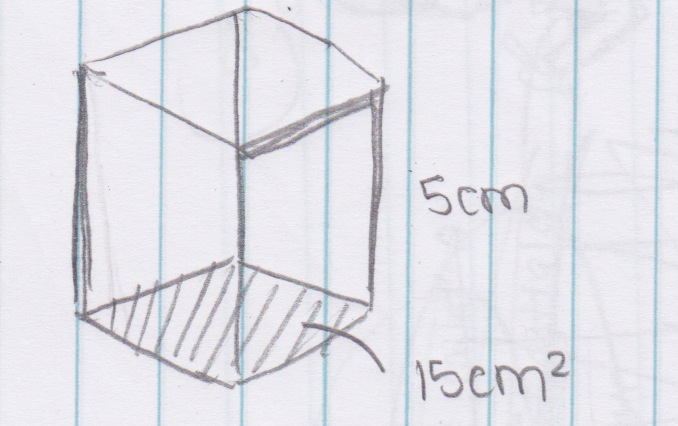
So, basically one centimeter cube would look like this:

And if you were to make one layer or a base out of the fifteen centimeter cubes used, it should look like this:

The area of the top of this one layer should be
15cm² so we will use that as our base.

Since the prism is made of
5 layers of those
15 centimeter cubes we will use that as our
height.
v= area of base x height
v= 15cm² x 5cm
v=75cm³
Though
worded differently it is basically asking for it's
volume.
v= area of base x height
v= 1250cm² x 100cm
v= 125 000cm³Here's a
link to calculating volume.
And two videos explaining both rectangular prisms and cylinders:
Cylinder Volume and Volume Problems

v=π x r x r x h
v=(3.14 x 12 x 12) x 15
v= 452.16cm^2 x 15 cm
v= 6782.4 cm^3
6782.4/4= 1695.6cm^3
Assume that 1/4 of the cheese was cut.

Cylinder one:
r= d/2
r =10/2
r= 5m
v= π x r x r x h
v= (3.15 x 5 x 5) x 30
v= 78.5 m^2 x 30m
v= 2355m^3
Cylinder two:
r= d/2
r= 8/2
r=4
π x r x r
(3.14 x 4 x 4)
50.24 m^2
2335m^3/ 50.24m^2= 46.5 m
I pray that I made any sense.